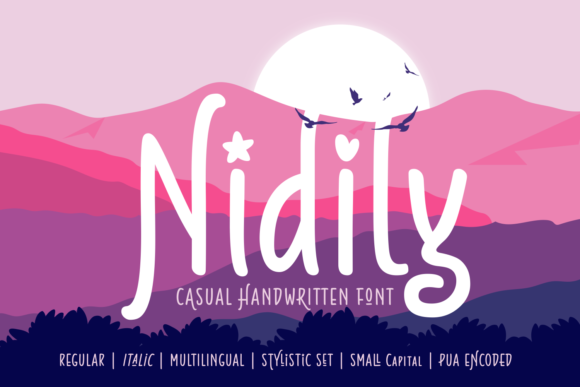
Nidily: A Sweet Script Font for Branding
I was sitting at my kitchen table last Tuesday, surrounded by stacks of matte paper labels and a half-empty cup of coffee. My client, a local artisan who makes small-batch soy candles, had hit a wall. Her product quality was exceptional, but her packaging felt disjointed. The logo was too rigid, the thank-you cards looked like they came from a corporate office, and her Instagram stories lacked that warm, inviting glow she wanted to project. We needed a typeface that could bridge the gap between professional reliability and handmade charm. That is when we pulled up Nidily.
As a creative consultant, I see hundreds of fonts. Most are forgettable. Some are trendy but fade quickly. But every so often, you find a script font that just feels right. Nidily, available through Script Amp, is one of those rare finds. It is not just a collection of letters; it is a mood. It carries a sweet, romantic vibe that instantly softens the visual language of a brand without sacrificing legibility or class.
Why Typography Makes or Breaks First Impressions
Before we dive into the specific curves of Nidily, let’s talk about why this matters. In the world of small business, especially for online sellers and boutique owners, your typography is often the first thing a customer notices. It sets the tone before they even read the words. A harsh, geometric sans serif might signal efficiency, but it can feel cold for a bakery or a beauty brand. A chaotic handwritten font might feel authentic, but if it is hard to read, it creates friction.
Nidily sits in that perfect middle ground. It is a premium font that offers the fluidity of a handwritten script but with the structural integrity of a well-designed display font. When we applied it to the candle labels, the change was immediate. The brand no longer looked like a hobbyist guessing at design; it looked like a curated experience. The loops are generous, and the connections between letters feel natural, mimicking the flow of a real pen but with digital precision. This consistency builds trust. Customers subconsciously associate clean, thoughtful design with high-quality products.
Putting Nidily to Work on Real Materials
We started testing Nidily across various touchpoints to see how it held up. Here is where this typeface truly shines in a practical business context:
- Packaging Design: For the candle jars, we used Nidily for the scent names. Because it is a script font, it draws the eye immediately. It feels personal, like the maker signed each jar. However, we kept the ingredient list in a clean sans serif font to ensure readability. This contrast is key in packaging design.
- Social Media Graphics: We refreshed the Instagram templates. Using Nidily for short, punchy headlines like "New Arrival" or "Behind the Scenes" added a layer of elegance. It works beautifully as a decorative accent over lifestyle photos, provided there is enough contrast between the text color and the background.
- Thank-You Cards: This was my favorite application. Printing "Thank You" in Nidily on thick, textured cardstock elevated the unboxing experience. It feels intimate and grateful, reinforcing the connection between the seller and the buyer.
- Website Banners: On the homepage, we used it for the main hero headline. It breaks up the monotony of standard web fonts and adds a human touch to the digital storefront.
The versatility of Nidily allows it to function as both a logo element and a supporting typography choice. It is not just for large headers; with careful sizing, it can work for subheadings in editorial design or blog graphics. However, I always advise against using it for long paragraphs. Its strength lies in its personality, which can become overwhelming if overused. Think of it as the jewelry of your brand identity—it accentuates, it does not carry the whole outfit.
Pairing and Readability Tips for Non-Designers
If you are a small business owner handling your own marketing, you might wonder how to pair this creative font. The rule of thumb is contrast. Since Nidily is organic and flowing, pair it with something structured. A modern sans serif font works best for body text, ensuring that your contact information, prices, and descriptions are easy to scan. If you want a more vintage or romantic look, a subtle serif font can complement the curves of Nidily nicely.
Readability is crucial, especially on mobile screens. When using Nidily for social media thumbnails or small product stickers, ensure the size is large enough. Intricate ligatures and swashes can blur if the text is too small. Always test your designs on a phone screen before printing hundreds of labels. What looks clear on a 27-inch monitor might look like a smudge on a 6-inch display.
Technical Details and Licensing Matters
Before you download and start designing, there are practical steps to take. Check the file formats included in the Script Amp package. You will typically need OTF or TTF files for desktop use in programs like Photoshop or Illustrator, and sometimes WOFF files for web design. Look for alternates and ligatures. These are optional character variations that allow you to customize the flow of the letters, preventing awkward collisions between specific characters like 'f' and 'i' or 't' and 'h'. Using these features can make your logo design or headline look bespoke rather than generic.
Also, always verify the commercial font licensing. If you are selling physical products like mugs, t-shirts, or printed books, ensure your license covers merchandise. Many designers overlook this, leading to legal headaches later. Nidily is designed for commercial use, but reading the specific terms ensures you are protected whether you are creating digital ads or physical packaging.
In the end, branding is about storytelling. Nidily tells a story of care, warmth, and attention to detail. It transforms a simple label into a keepsake and a generic post into an invitation. For any entrepreneur looking to polish their brand identity, investing in a high-quality typeface like this is one of the most cost-effective upgrades you can make. It does not just change how your business looks; it changes how your customers feel when they interact with it.